Most businesses don’t lose US opportunities because their product is poor.
They lose them because of FDA misunderstanding.
A buyer asks one simple question:
“Are you US FDA certified?”
Behind that question sits regulation, compliance, risk, and trust. This version of the blog is written in a question–answer and decision-driven format, the same way buyers, distributors, and compliance teams actually think.
What Do Buyers Really Mean by “US FDA Certificate”?
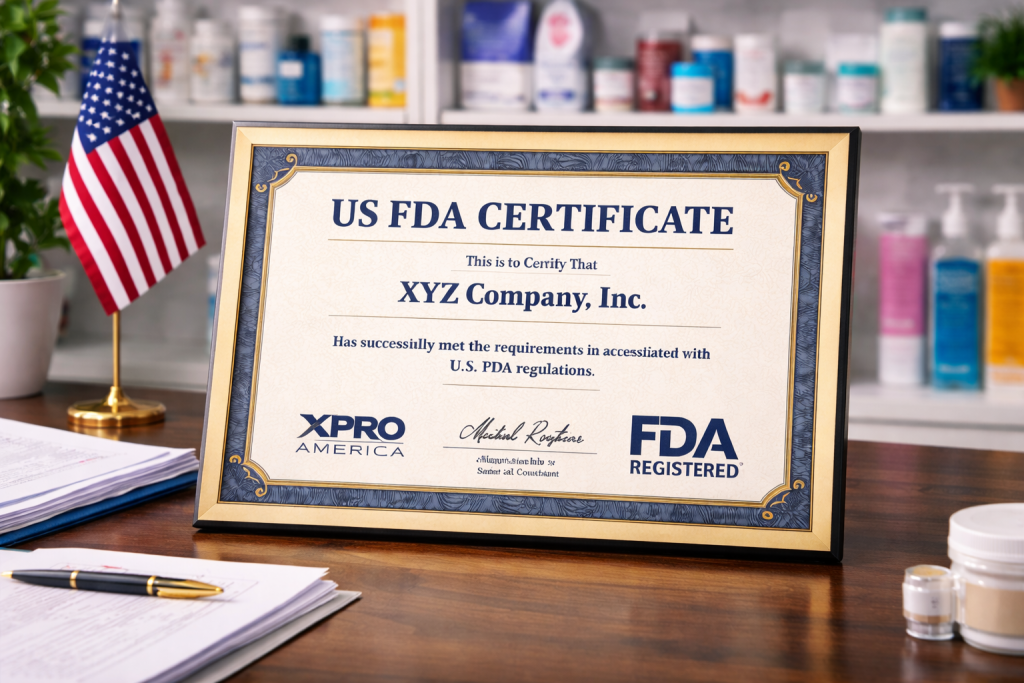
When buyers say US FDA certificate, they are not usually asking for a decorative PDF.
They want to know:
- Is your facility registered with the FDA?
- Are your products properly listed or approved?
- Can your shipment clear US customs without issues?
All of this is governed by the U.S. Food and Drug Administration.
In business language, FDA certified means FDA compliant for US market entry.
Is a US FDA Certificate a Single Document?
No—and this is where confusion begins.
There is no one-size-fits-all FDA certificate.
Instead, FDA compliance may include:
- Facility registration confirmation
- Product listing records
- Clearance or approval letters (for regulated products)
Each product category follows a different regulatory route.
Why FDA Compliance Is Non-Negotiable
FDA compliance is required because it protects:
- Consumers (safety and quality)
- Importers (legal liability)
- Your business (market access)
Without valid FDA registration:
- Shipments can be detained or refused
- Importers may reject contracts
- Online platforms may block listings
In short, no FDA compliance = no US market stability.
Does FDA Apply Only to US-Based Companies?
Absolutely not.
FDA regulations apply globally to any product entering the United States.
It does not matter where you manufacture.
What matters is where you sell.
If the destination is the US, FDA rules apply in full.
How Businesses Actually Get a US FDA Certificate
Forget complicated explanations. FDA compliance follows a logical structure:
1. Product Category Comes First
FDA rules differ for food, drugs, medical devices, cosmetics, and dietary supplements.
2. Facility Registration Is Mandatory
Manufacturing or processing sites must be registered with FDA.
3. Product Listing or Approval
Applicable products must be listed or cleared under FDA rules.
4. US FDA Agent Appointment
Non-US companies must appoint a US FDA Agent for official communication.
5. Compliance Must Be Maintained
Annual renewals, updates, and record accuracy are required.
FDA compliance is ongoing, not one-time.
Why Many Companies Think They Are FDA Certified (But Aren’t)
Common real-world mistakes:
- Registering the facility but skipping product listing
- Assuming one registration covers all products
- Confusing local licenses with FDA compliance
- Using outdated or unverifiable documents
These errors usually surface only when a shipment is already in transit.
This is why businesses work with experts like XPRO America—to prevent silent failures.
US FDA Certificate Cost: What You Should Expect
There is no flat FDA certificate price.
Costs depend on:
- Product category and risk level
- Number of facilities and products
- FDA annual user fees
- US FDA Agent and compliance support
The real cost of FDA compliance is not registration—it’s getting it wrong.
Why Importers Ask for FDA Proof Before Anything Else
US buyers request FDA documentation because it:
- Confirms legal eligibility to sell
- Reduces compliance and recall risk
- Protects their brand and supply chain
Even strong demand cannot override FDA non-compliance.
How to Check and Verify US FDA Registration
FDA registrations can be verified through:
- FDA public records
- Facility Establishment Identifier (FEI) data
- Registration confirmation details
However, verification requires understanding what the data actually means. Misinterpretation can cost deals.
FDA Certificate Download: What’s Real and What’s Risky
There is no universal FDA certificate PDF issued for all businesses.
Depending on your product, valid documents may include:
- Registration acknowledgments
- Listing confirmations
- Approval or clearance letters
Any document shared must match your actual FDA status—anything else damages credibility.
The 5 Product Categories Regulated by FDA
FDA oversight covers:
- Drugs
- Medical Devices
- Food & Beverages
- Cosmetics
- Dietary Supplements
Each category follows its own rules, timelines, and compliance depth.
Why XPRO America Is Trusted for FDA Compliance
Businesses worldwide work with XPRO America because we provide:
- Accurate FDA registration & listing
- US FDA Agent services
- Clear compliance strategy
- Renewal and lifecycle support
- Business-first regulatory guidance
We don’t just file—we protect your US market access.
Final Thought for Decision-Makers
A US FDA certificate is not a formality.
It is proof that your business can operate safely and legally in the US market.
Get it right, and growth becomes predictable.
Get it wrong, and opportunities disappear quietly.
Contact XPRO America – US FDA Consultancy
📧 Email: support@xproamerica.com
Leave a Reply